Wesley College
Second Professional Practice
2025 | Five weeks | Assessment: 75 — Distinction

My five-week professional experience at Wesley College provided an extended opportunity to plan and deliver Visual Arts and Design & Technologies learning across junior, middle and senior year groups within an independent boys’ school environment.
Working across Years 5–12 strengthened my ability to adjust teaching language, demonstrations, scaffolding and feedback according to students’ ages, prior experience and individual confidence. The extended placement also allowed me to develop stronger relationships with students, follow projects through multiple stages and become actively involved in the wider life of the College.
Throughout the placement, I developed complete lessons and original teaching resources, delivered practical demonstrations, monitored student progress and provided individual feedback. I contributed to safe and productive classroom and workshop environments while supporting students through research, idea development, experimentation, fabrication, construction, refinement and presentation.
My Second Professional Practice was assessed at 75, achieving a Distinction.


YEAR 6 VISUAL ARTS — BIRD DRAWING AND SCULPTURE
Year 6 students developed observational bird drawings before translating their visual
research into three-dimensional bird sculptures. The sequence supported students in
examining shape, proportion, texture, pattern and form while understanding how
observations made through drawing could inform a sculptural outcome.
During the drawing stage, I encouraged students to look carefully at the structure and
distinctive features of different birds rather than relying on simplified or symbolic
representations. Visual exemplars, guided observation and targeted questioning
supported students in identifying details that made their chosen birds recognisable.
Students then applied their observations to three-dimensional construction. I used
step-by-step demonstrations and scaffolded processes to help students understand
how forms could be built, joined and refined. Individual support was adjusted
according to each student’s practical confidence and stage of development.
The project allowed students to move between two-dimensional and three-dimensional
ways of thinking. It also encouraged persistence, problem-solving and creative
decision-making as students adapted their original drawings into resolved sculptural
forms.
YEAR 9 VISUAL ARTS — SKATEBOARD DESIGN
The Year 9 skateboard-design project combined visual research, composition, graphic
imagery and personal expression. Students developed imagery suited to the elongated
skateboard format while considering how colour, scale, placement and the relationship
between visual elements contributed to a cohesive design.
I supported students through idea generation, experimentation and refinement. Visual
references and exemplars helped students consider different approaches to skateboard
graphics, while individual feedback encouraged them to develop imagery that reflected
their own interests and creative intentions. Students were encouraged to move beyond
their first idea by testing alternative compositions, adjusting scale and considering how
their design would be viewed across the complete skateboard surface. Targeted questioning
helped students explain their decisions and identify areas requiring further development.
The project strengthened my ability to support a class in which students were working on
highly individual outcomes while still progressing through a shared design and refinement
process.
YEAR 12 GENERAL VISUAL ARTS — PAINTING/DRAWING
I supported Year 12 General Visual Arts students as they developed paintings, drawings
and individual bodies of work. At the senior-secondary level, my teaching focused on
artistic intention, experimentation, material decisions and the progressive refinement of
personal work. I held individual discussions with students about their concepts, visual
choices and the relationship between their ideas and selected processes. Students were
encouraged to evaluate whether their materials, imagery, composition and presentation
effectively communicated their intentions.
Rather than directing students towards identical solutions, I used questioning and
feedback to help them identify possibilities for extending their own work. This supported
students to retain ownership of their creative decisions while continuing to experiment,
refine and resolve their outcomes.
YEAR 12 GENERAL VISUAL ARTS — CERAMICS
I also supported Year 12 General Visual Arts students as they developed ceramic work.
Students required different levels of assistance depending on their concepts, technical
experience and stage of production. My role involved discussing artistic intention,
supporting practical problem-solving and encouraging students to consider how form,
surface, texture and presentation contributed to the communication of meaning.
Working with senior ceramics students strengthened my ability to provide technical
guidance without taking control of the creative process. I encouraged students to evaluate their work regularly, respond to emerging material challenges and make purposeful decisions as their pieces developed.
YEAR 12 SHOWCASE AND STUDENT FEEDBACK
I attended the Year 12 showcase, where students presented their developing work and received feedback from teachers, families and members of the school community. During the showcase, I held numerous individual conversations with students about their progress, artistic intentions and possible ways to extend their ideas, experimentation and technical resolution. I encouraged students to consider what was already successful, where their intentions could be communicated more clearly and what further risks or refinements might strengthen their work.
These conversations gave me valuable experience in providing constructive feedback within an authentic presentation context. They also demonstrated how dialogue with students can help them clarify their intentions, recognise possibilities and take greater responsibility for the direction of their work.
DESIGN & TECHNOLOGIES TEACHING
YEAR 5 DESIGN & TECHNOLOGIES — WOOD SCULPTURE
The Year 5 wood-sculpture project introduced students to practical workshop processes while
incorporating Aboriginal perspectives within the College’s existing program.
Students were supported in developing their designs, handling materials responsibly and
progressively transforming timber into three-dimensional outcomes. Working with younger
students required demonstrations to be highly visual, concise and carefully sequenced. My
teaching emphasised appropriate tool handling, PPE, active supervision and respect for the
cultural ideas connected with the project. I regularly checked student understanding and
practical readiness before allowing students to progress to the next stage.
This experience strengthened my ability to introduce younger students to workshop
expectations while maintaining enthusiasm, creativity and a strong focus on safety.
YEAR 9 METALWORK — METAL DICE
The Year 9 metal dice project developed students’ skills in measurement, marking out, metal fabrication, welding, grinding, drilling and finishing. Students were required to work accurately and follow a carefully sequenced production process to transform steel components into a resolved three-dimensional form.
Equipment and tools used during the project included the MIG welder and welding gun,
oxy-acetylene torch, angle grinder, pedestal grinder, drill press, bench vice, clamps,
welding magnets, hacksaw, metal files and measuring and marking tools. Students
measured and marked their materials using steel rules, engineer’s squares, scribers
and centre punches. Components were prepared, positioned and secured before welding.
MIG welding was used to join steel sections, while grinding and filing processes were used
to clean welds, refine edges and improve the overall finish. The drill press and centre punch
supported the accurate placement of the dice markings. Workshop safety was embedded throughout
the project. Students were expected to follow demonstrations, wear task-appropriate PPE and use
machinery only after receiving instruction. PPE included safety glasses, welding helmets, hearing
protection, protective clothing, welding gloves and enclosed footwear.
The project encouraged accuracy, patience and persistence. Students regularly evaluated their construction,
identified areas requiring correction and refined their work through progressive grinding, filing and finishing.
Supporting this project strengthened my ability to monitor multiple students working at different stages while maintaining clear safety expectations, active supervision and appropriate access to equipment.
YEAR 12 GENERAL WOOD — TABLE CONSTRUCTION
I supported Year 12 General Wood students as they developed and refined substantial individual table projects. Students were required to make considered decisions about materials, dimensions, construction processes,
accuracy and finish. I provided practical guidance while encouraging students to evaluate their own progress, identify construction challenges and determine appropriate solutions. My support included reinforcing safe workshop practice, assisting students with material and process decisions and providing feedback on accuracy, stability, refinement and presentation.
Working with senior students strengthened my capacity to balance direct technical assistance with opportunities for students to work independently, solve problems and take responsibility for the quality of their outcomes.
YEAR 12 VISUAL ARTS DISPLAY CABINET
I designed and constructed a wooden display cabinet for a Year 12 Visual Arts student to use in presenting their body of work. The cabinet responded to the student’s individual artwork and presentation needs. Its development required me to consider the dimensions, structure, materials, finish and relationship between the display furniture and the artworks it would support.
This project allowed me to apply my Design & Technologies skills within a Visual Arts context and develop a practical solution that strengthened the student’s presentation.
It also demonstrated the value of interdisciplinary collaboration. The cabinet was not simply a piece of furniture; it became part of the student’s overall visual presentation and helped create a more considered relationship between the artwork, display method and audience experience.
PLANNING AND ORIGINAL TEACHING RESOURCES
Throughout the placement, I planned complete lessons and developed original
resources to support student understanding and independence. Resources
included visual exemplars, staged instructions, demonstration materials and
project-specific guidance. These were designed to make practical processes
easier to follow and to provide students with points of reference while they
worked. I used clear learning intentions and sequenced activities so students
understood both what they were making and the skills or ideas being developed.
Regular progress checks helped me identify misconceptions, respond to practical
difficulties and adjust support.
Developing resources for different year levels strengthened my ability to consider language, visual clarity, accessibility and the amount of information students could manage at each stage of a project.
DIFFERENTIATION AND STUDENT SUPPORT
Students entered practical and creative classes with different levels of confidence, prior experience, organisation and willingness to experiment. I differentiated support through visual modelling, scaffolded processes, repeated demonstrations, targeted questioning and individual assistance. Some students required reassurance and a clear starting point, while others benefited from questions that challenged them to extend or refine their work.
I monitored individual progress and adjusted my support according to each student’s readiness. This allowed students to participate in shared projects while still receiving assistance appropriate to their needs. My approach was to provide enough structure for students to feel safe and capable without removing opportunities for independence, experimentation and personal decision-making.
ASSESSMENT AND FEEDBACK
Formative assessment was embedded throughout my teaching. I used observation, questioning, progress discussions and examination of works in progress to identify student understanding and determine the next stage of support. Feedback was specific to the student’s project, intentions and stage of production. Rather than giving only general praise, I aimed to identify what was working, explain what required further attention and suggest practical or conceptual directions for improvement.
The Year 12 showcase, lunchtime studio access and after-school Art Club provided additional opportunities to hold more sustained conversations with students about their progress.
These experiences strengthened my understanding that effective feedback should be timely, constructive and connected to both the student’s intentions and the relevant learning goals.
SAFE WORKSHOP PRACTICE
Safety was a consistent priority across Woodwork and Metalwork classes. I reinforced workshop routines, PPE requirements, safe operating procedures and responsible use of tools, machinery and materials. Before students used equipment, I supported clear demonstrations and checked that students understood the process and relevant hazards. Active supervision was maintained while students worked, particularly when welding, grinding, drilling or using powered machinery.
I monitored movement, material storage, work areas and student readiness. Students were reminded that access to equipment depended on following instructions and demonstrating safe behaviour.
This placement strengthened my confidence in maintaining a workshop environment where technical learning, independence and creativity could develop within clear safety expectations.
CLASSROOM MANAGEMENT AND STUDENT RAPPORT
Across the placement, I used calm, consistent classroom-management strategies and worked to establish positive professional relationships with students. Clear instructions, predictable routines and visible teacher presence helped maintain productive learning environments. In practical classes, I moved continuously through the room or workshop, monitored progress and addressed emerging issues before they disrupted learning or created safety concerns.
The five-week duration allowed students to become familiar with my expectations and teaching approach. It also enabled me to understand individual personalities, working habits and support needs more fully. Students increasingly approached me to discuss their work and seek feedback, including students outside my timetabled classes. The value of these interactions was reinforced when students whom I had not formally taught later expressed that the feedback I had provided had been helpful in progressing their work. This demonstrated the importance of being visible, approachable and genuinely interested in students’ creative development while maintaining appropriate professional boundaries.
LUNCHTIME STUDIO ACCESS
I regularly remained in the Art Department during lunchtimes so students could continue developing their work. During these sessions, I provided practical assistance, encouragement and feedback when required. The quieter environment allowed students to work with greater continuity and created opportunities for more focused individual conversations. Students were able to revisit areas they had found difficult, gain clarification and make progress beyond the limitations of scheduled class time.
These sessions also allowed me to build stronger rapport with students and demonstrate a commitment to supporting their progress beyond my formal teaching allocation.
WEEKLY AFTER-SCHOOL ART CLUB
I participated in a weekly after-school Art Club, supporting students who wanted additional time to develop and refine their projects. The Art Club environment encouraged experimentation, extended making and informal discussion. Students could seek feedback, test ideas and continue work that required more time than was available during regular lessons.
My involvement allowed me to support students from different classes and year groups and contribute to the broader creative culture of the College. It also demonstrated the importance of co-curricular Arts programs in giving students additional opportunities to develop skills, confidence and a sense of belonging within the school community.
STUDENT EXHIBITION
I assisted with preparing and installing a student exhibition, contributing to the considered
presentation and celebration of student achievement. This involved supporting the organisation and display of artworks so they could be viewed clearly and respectfully by an audience. The installation process required attention to arrangement, spacing, visual relationships and the practical requirements of presenting different types of work.
The experience reinforced the value of exhibitions in giving student work an authentic audience, recognising sustained effort and strengthening connections between students, families and the school community.
It also demonstrated how thoughtful presentation can influence the way an artwork is understood and valued.
YEAR 12 SHOWCASE AND COMMUNITY ENGAGEMENT
Attending the Year 12 showcase allowed me to observe and participate in an important point of connection between students, teachers, families and the wider College community. Students had the opportunity to discuss their work and receive feedback in a setting that recognised the seriousness of their creative practice. I contributed by speaking with students about their progress, artistic intentions and possible directions for further development.
The showcase reinforced the importance of involving families in the learning process and creating opportunities for students to communicate the thinking behind their work. It also strengthened my confidence in discussing student progress respectfully and constructively within a community setting.
ATHLETICS CARNIVAL
Beyond the Visual Arts and Design & Technologies learning areas, I contributed to the College athletics carnival as a shot put facilitator. I supported the safe and orderly running of the event, communicated instructions to students and helped maintain an encouraging environment. At the conclusion of the carnival, I remained after school to assist staff with packing away equipment and materials.
This experience demonstrated my willingness to contribute beyond my specialist teaching areas and support the practical work required to deliver whole-school events successfully.
PROFESSIONAL COLLABORATION
Throughout the placement, I worked collaboratively with mentor teachers, technical staff and members of the wider College community. I sought guidance, responded to feedback and reflected on how lessons and interactions could be improved. Working alongside experienced teachers strengthened my understanding of curriculum planning, classroom management, assessment, workshop organisation and professional responsibility.
Collaboration with technical staff reinforced the importance of preparation, equipment management, material availability and clear communication in supporting safe and effective practical programs. The placement demonstrated that successful Visual Arts and Design & Technologies teaching depends not only on individual classroom practice but also on strong professional relationships and coordinated teamwork.
CONTRIBUTION TO THE COLLEGE
Throughout my placement, I actively sought opportunities to contribute beyond my scheduled teaching responsibilities. I regularly remained in the Art Department during lunchtimes, participated in weekly after-school Art Club, attended the Year 12 showcase, assisted with installing a student exhibition and constructed a wooden display cabinet for a Year 12 student’s body of work.
I contributed to the athletics carnival as a shot put facilitator and remained after
school to assist with packing away equipment and materials. My broader involvement strengthened my relationships with students and staff and allowed me to contribute to the creative, co-curricular and community life of the College.
These experiences developed my understanding of the professional commitment, communication, teamwork and willingness to participate required to support a thriving independent-school community.
REFLECTION
Wesley College was a highly valuable and formative professional experience. The five-week placement allowed me to teach across Years 5–12, work within Visual Arts, Woodwork and Metalwork, develop complete lessons and resources and contribute to the wider life of the College. The extended placement enabled me to follow student progress over time, refine my teaching in response to feedback and build strong professional relationships with students and staff. I developed greater confidence in practical demonstrations, differentiation, formative assessment, workshop safety and the management of busy creative learning environments. I also strengthened my ability to support senior students through individual feedback while encouraging ownership of their artistic and technical decisions.
My involvement in lunchtime studio access, after-school Art Club, exhibitions, the Year 12 showcase and the athletics carnival reinforced that meaningful teaching extends beyond scheduled lessons. The placement confirmed my strong interest in working within an independent-school environment where academic learning, practical skill development, creative opportunity, pastoral relationships and co-curricular contribution are all valued.


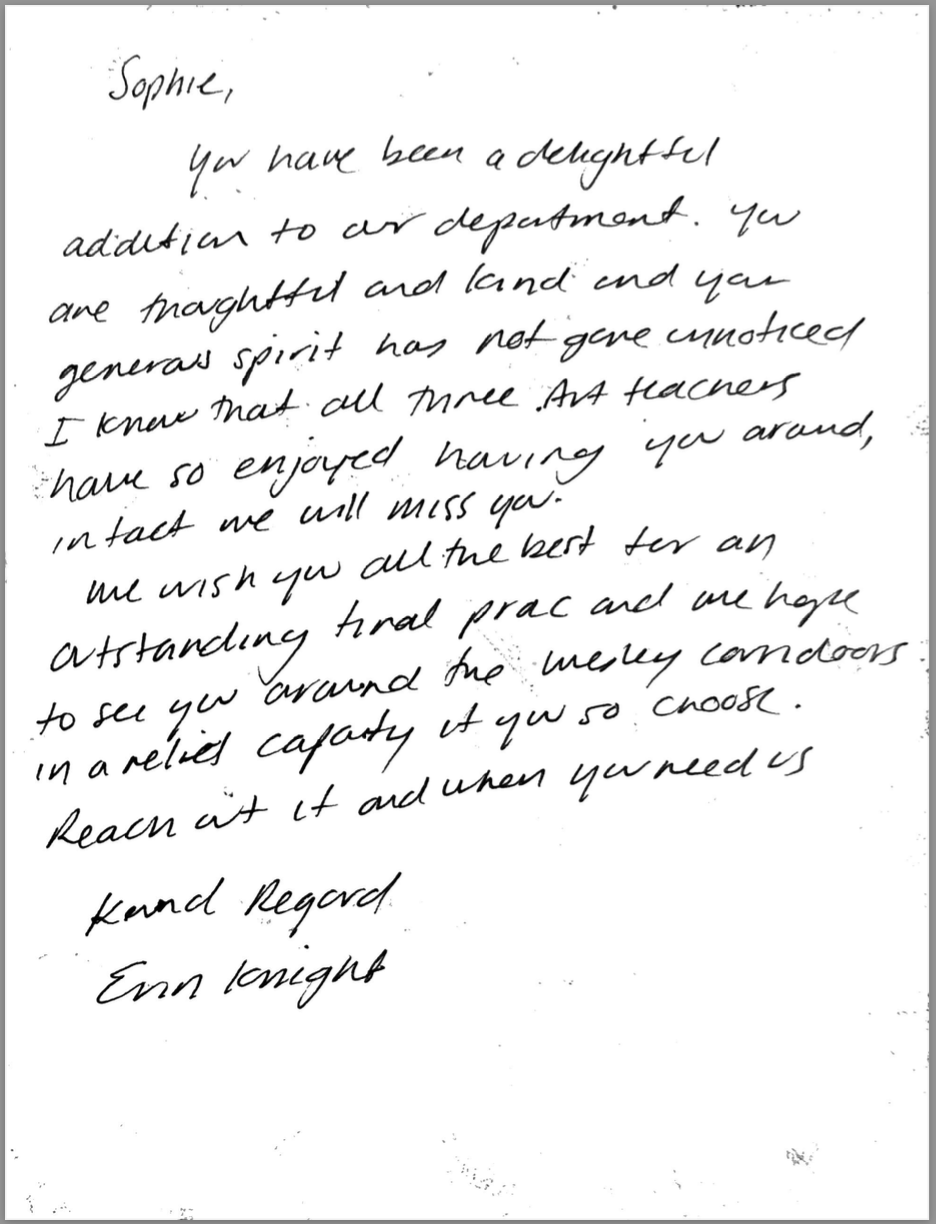
Letter from Head of Art Department - Erin Knight